Over twenty countries have taken action to reduce exposures to their citizens.
From the Environmental Health Trust Briefing
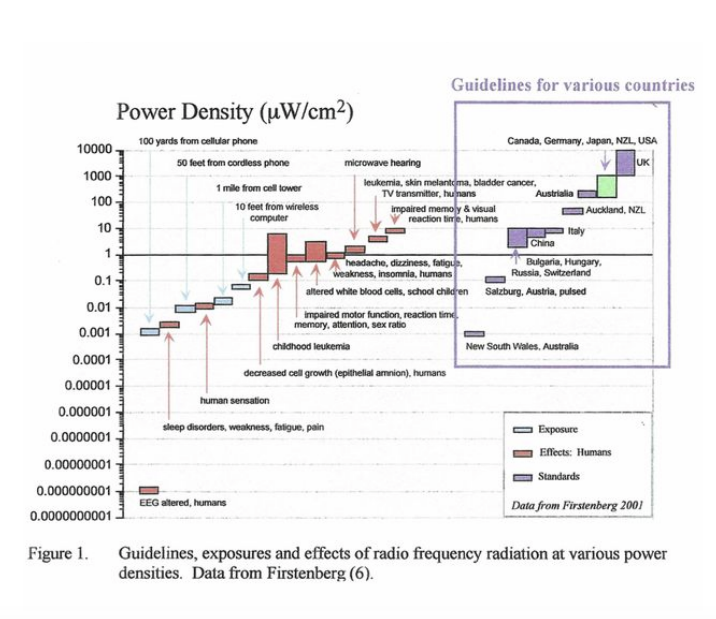
This is how the US compares to other countries in terms of allowable radiation exposure.
This is why MCPS and PGCPS wireless systems will always be "legal" and "not breaking any laws".
Simply put- "the law" allows sky high radiation.
The above picture shows how the United States and the UK have the most lenient RR-EMF wireless radiation limits in the world. Other countries have set radiation limits far lower than the US in recognition of non thermal effects which could pose a risk to public health.
(Slide is from the presentation by Dr Erica Mallery-Blythe, MD at the Commonwealth Club of CA, 5/2015)
INTERNATIONAL PRECAUTIONARY ACTIONS
by Governments, Authorities and Schools
(Please go to source documents by clicking on underlined hyperlink.)
France: New National Legislation and the National Agency for Health, Food and Environmental Safety Report.
WiFi Banned in Nursery Schools: WIFI and Wireless devices will be banned in “the spaces dedicated to home, to rest and activities of children under 3 years”.
WiFi on “OFF” as Default to Minimize Exposures in Schools: In elementary schools,WIFI routers should be turned off when not in use.
Schools Will be Informed: The school board should be informed when new tech equipment is being installed.
Cell Tower Emission Compliance Will Be Verified: A decree will define the limits of emission of equipments for electronic communications or transmission to which the public is exposed. These values can be verified by accredited organizations and results will be made accessible to the public through a National Radiofrequency Agency.
Citizens Will Have Access to Environmental/Cell Tower Radiation Measurements Near homes: Every resident may get access to the results of measurements for their living space.
Cell Antennae Maps For the Country: A description and map of the places with atypical (higher than the limits) places will be conducted at regular intervals with follow up of the actions being taken to limit the exposure. A map of all antennas will be produced for each town.
Continued Evaluation of Health Effects: The National Radiofrequence Agency will be in charge of surveillance and vigilance, evaluating potential risks and setting up scientific research, including information on health effects.
SAR Radiation Labeling Mandated: The SAR of cell phones must be clearly indicated on the package.
Information on Reducing Exposures Mandatory: Information on ways to reduce exposure will be detailed in the contents of the cell phone package. .
WIFI Hotspots will be Labeled: Places where WIFI is provided should be clearly marked with a pictogram.
Advertisements Must Recommend Devices That Reduce Radiation Exposure to the Brain: Advertising for cell phones should clearly indicate the recommendation of hand free kits for protection of the head of the user and it will be included in the package. Advertising for cell phone not accompanied by such a kit is forbidden. Companies in violation will be fined 75,000 Euros.
Children Must Be Provided Protections: At the request of the buyer, equipment reducing cell phone radiation exposures to the head for children less than 14 years should be provided.
The Public Will Be Informed: Within a year, a policy of information on awareness and information on a responsible and reasonable use of cell phones and other apparatus emitting radiofrequencies will be set up.
Electrohyper-sensitivity Report To Be Submitted: Within a year, a report on electrohyper sensitivity must be given to the Parliament.
2011 French Cell Phone Statute: Merchants must display SAR Radiation levels for different phone models, all phones must be sold with a headset, cell phone ads aimed at children younger than 14 are banned and phones made for children under 6 are banned.
2013 ANSES Report recommends hands free phones, SAR labeling, and “limiting the population's exposure to radiofrequencies… especially for children and intensive users, and controlling the overall exposure that results from relay antennas.”
-
-
Phones designed for children under 7 years old are prohibited from sale.
Total Advertising Ban on cell phones aimed at children younger than 14.
Mandatory Radiation SAR levels must be available for consumers at point of sale.
Warning label on phones: “Think about your health – use your mobile phone moderately, make your calls wearing an earpiece and choose a set with a lower SAR value.”
Recommendations include use of hands-free methods to keep the phone away from the body such as text messaging and not making calls when the signal is weak, such as in elevator/vehicle.
Ghent Municipality: Wireless internet is banned from spaces that cater to children between 0 and three: preschools and daycares to reduce exposure to microwave radiation.
Belgium has set a RF limit of 3V/m (at 900MHz) for cell antennas in certain locations such as indoors, schools, and playgrounds.
The Parliament voted to adopt a resolution which calls to implement the Parliamentary Assembly of the Council of Europe resolution 1815 of 2011, which recommends to "review the scientific basis for the standards of exposure to electromagnetic fields" and " set thresholds for levels of preventive long-term exposure in all indoor areas not exceeding 0.6 volts per meter ".
The Vitoria City Council unanimously approved a precautionary approach with wireless: Citizens will be informed of the location of wireless transmitters are in civic centers and municipal buildings. It is recommended that children's spaces such as playgrounds and family libraries, will be free of WiFi or have decreased wifi and wifi free zones will be established in playgrounds and building entrances.
Canada: Health Canada offers “Practical Advice” on reducing exposure to wireless radiation.
Recommendations: 1. Limit the length of cell phone calls, 2. Replace cell phone calls with text, use "hands-free" devices and 3. Encourage children under the age of 18 to limit their cell phone usage
2015: National Bill C-648 Introduced into the House Of Commons,“An Act Respecting the Prevention of Potential Health Risks From Radiofrequency Electromagnetic Radiation” would require manufacturers of all wireless devices to place specific health warning labels clearly on packaging, or face daily penalties /fines and/or imprisonment.
-
Australia: In 2013 the Australian Radiation Protection and Nuclear Safety Agency issued Fact Sheet 14: titled How to Reduce exposure from mobile phones and other wireless devices.
Reduce the risk from WiFi devices by “keeping them at a distance, for example placing the wireless router away from where people spend time”, and “reducing the amount of time you use them”.
“ARPANSA recommends that parents encourage their children to limit their exposure.”
Italy:
-
1. To replace existing wireless networks whenever possible with networks that emit less radiation at schools, preschools, hospitals, nursing homes, and other public facilities.
2. Establish a working group whose mandate it is to assess these new technologies and their exposure levels. With regard to wireless communication technologies, mobile Internet access, and public health, the working group shall clarify which technologies emit less radiation and provide sustainable technology options and
-
The Italian Supreme Court ruled a man’s brain tumor was caused by his cell phone use in 2012. The National Institute for Workmen’s Compensation must compensate a worker with head tumor due to cell use.
Finland: The Radiation and Nuclear Safety Authority issued recommendations for children which include: favoring text messages, parents limiting duration and amount of calls,the use of hands free devices, avoiding calls in a low reception area and keeping the phone away from the body.
"With children, we have reason to be especially careful, because there is not enough research on children's mobile phone use", according to STUK research director Sisko Salomaa.
Preschool through 2nd grade have banned the use of wireless networks. In third and fourth grade class internet is restricted to 3 hours per week.
A hard wired direct cable connection is required if the teacher has a computer in the class.
Magnetic fields below 4mG are being reduced in schools representing the government's position that international guidelines are NOT protective of children.
-
In third and fourth grade class internet is restricted to 3 hours per week.
-
Israel's Minister of Health Rabi Litzman stated that he supports a ban on Wi-Fi in schools.
A hard wired direct cable connection is required if the teacher has a computer in the class.
-
-
- The Ministry of Health published Environmental Health in Israel 2014 which states that “Precautions should be strictly enforced with regard to children, who are more sensitive to developing cancer.” and that "wireless communication networks in schools be reduced." The Health Ministry recommends “sensible use of cellular and wireless technology, including: considering alternatives like landline telephones, use of a speaker while talking on a cellphone, and refraining from installing the base of wireless phones in a bedroom, work room, or children’s room.”
- The Report states that “Findings in Israel clearly indicated a link between cellphone use for more than 10 years and the development of tumors in the salivary glands, particularly among people who held the telephone on the same side where the tumor developed and individuals in the highest category of exposure (heavy use in rural areas).”
- Linda S. Birnbaum, Director, USA National Institute of Environmental Health Sciences and National Toxicology Program wrote in the Report that, “ If some of the studies turn out to be harbingers of things to come, we may have major health consequences from the nearly ubiquitous presence of wireless equipment.”
Switzerland: The Governing Council of Thurgau Canton 2008 “The Governing Council recommends for schools to forgo the use of wireless networks when the structural makeup of a given school building allows for a wired network.“
Germany: The German Federal Ministry for Radiation Protection states,”supplementary precautionary measures such as wired cable alternatives are to be preferred to the WLAN system.”
Bavaria: The State Ministry of Education and Cultural Affairs: “For precautionary reasons the Federal Office for Radiation Protection recommends for schools that if a wireless network is used to place its components in suitable locations and to prefer the use of wired network solutions whenever possible.” In 2007 Parliament recommendation to all schools to not install wireless LAN networks.
Frankfurt: “In Frankfurt’s schools there will be no wireless networks in the short or mid term. The Local Education Authority did not wish to conduct a “large scale human experiment,” said Michael Damian, spokesperson of the Head of the School Department Jutta Ebeling.
Austria:
The Austrian Medical Society has issued cell phone safety guidelines stating that cell phones should be used for as short of a time as possible and that children under 16 should not use cell phones at all. They also state that “wireless LAN leads to high microwave exposure”.
India: 2012 The Ministry of Communications and Information Technology issued EMF guidelines with new Exposure Limits lowered to 1/10 of the ICNIRP level, SAR labeling on phones.
Official guidelines for cell phone use include: Headsets, Speakerphones, limiting cell use, increasing distance from devices, and choosing landlines.
2013: Supreme Court of India upheld the High Court of the State of Rajasthan decision to remove all cell towers from the vicinity of schools, hospitals and playgrounds because of radiation “hazardous to life.”
The Ministry of Communications and Information Technology has an EMF webpage
-
Russia: The Russian Federation advises that those under the age of 18 should not use a mobile phone at all, recommends low- emission phones; and requires the following: on-device labelling notifying users that it is a source of RF-EMF, user guide information advising that ‘‘it is a source of harmful RF-EMF exposure’’ and the inclusion of courses in schools regarding mobile phones use and RF-EMF exposure issues. The Russian National Committee on Non-Ionizing Radiation Protection has repeatedly warned about electromagnetic radiation impacts on children and recommended WiFi not be used in schools.
“Thus, for the first time in the human history, children using mobile telecommunications along with the adult population are included into the health risk group due to the RF EMF exposure.”
“In children, the amount of so-called stem cells is larger than in adults and the stem cells were shown to be the most sensitive to RF EMF exposure.”
“It is reasonable to set limits on mobile telecommunications use by children and adolescents, including ban on all types of advertisement of mobile telecommunications for children.”
-
European Environment Agency: “All reasonable measures to be taken to reduce exposures to electromagnetic fields, especially radiofrequencies from mobile phones and particularly the exposures to children and young adults. Current exposure limits to be reconsidered.”
United Kingdom: The UK National Health Service offers specific Recommendations for children and cell phones as “children are thought to be at higher risk of health implications”.
“Children should only use mobile phones for essential purposes and keep all calls short. “
For the public they have “recommendations to help lower any potential long-term risks” which include keeping calls short, keep phone away from the body on standby mode, only use it when the reception is strong and use a phone with an external antenna.
Cyprus: October 2015, The Cyprus National Committee on Environment and Child Health (ECH) says it wants to err on the side of caution, warning the public that using mobile devices could be potentially harmful to children. Stella Michaelidou, President of the ECH, states that society should respond by taking precautions because “Documentation of other potential and more serious biological side effects are on the tip of an emerging iceberg.”
Resolution 1815: In 2011 The Parliamentary Assembly of the Council of Europe issued
The Potential Dangers of Electromagnetic Fields and Their Effect on the Environment.
A call to European governments to “take all reasonable measures” to reduce exposure to electromagnetic fields “particularly the exposure to children and young people who seem to be most at risk from head tumours.” The Resolution calls for member states to:
Implement “information campaigns about the risk of biological effects on the environment and human health, especially targeting children and young people of reproductive age. “
“Reconsider the scientific basis for the present standards on exposure to electromagnetic fields set by the International Commission on Non-Ionising Radiation Protection, which have serious limitations, and apply ALARA principles, covering both thermal effects and the athermic or biological effects of electromagnetic emissions or radiation.”
“For children in general, and particularly in schools and classrooms, give preference to wired Internet connections, and strictly regulate the use of mobile phones by schoolchildren on school premises.”
|
United States: Legislation has been introduced at the state and national level. Some Communities have issued proclamations, resolutions and and started initiatives to inform the public of wireless health issues.
"The City of Berkeley requires that you be provided the following notice:
To assure safety, the Federal Government requires that cell phones meet
radio frequency (RF) exposure guidelines. If you carry or use your phone
in a pants or shirt pocket or tucked into a bra when the phone is ON and
connected to a wireless network, you may exceed the federal guidelines
for exposure to RF radiation. Refer to the instructions in your phone or user manual for information about how to use your phone safely." Full text here.
2014 New York: Wireless Router Labeling in all Suffolk Public buildings: 12/2014 The Suffolk County Legislature passed legislation to require all county buildings to post notices that wireless routers are in use such as, "Notice: Wireless technology in use." The resolution, sponsored by Legis. William Spencer (a physician), warns that every wireless device emits radio frequency radiation or microwave radiation. It notes that studies "that have looked at the effects of low-level RFR radiation on human cells and DNA have been inconclusive." Read Press Release.
-
1. Alert citizens about the fine print warnings and possible health risks of cell phones and wireless devices By sharing the Environmental Health Trusts 10 Steps to Safe Tech and Doctors Advice on Cell Phones Brochure in City health fairs and city centers.
2. To send the FCC Chairman a letter urging the adoption of “radiation standards that will protect human health and safety.”
3. To oppose cell towers on school grounds and write a letter to the local school board and County Executive.
US Proposed Legislation
2012 National Law The Cell Phone Right to Know Act H.R. 6358 was introduced receiving strong support from many organizations including the American Academy of Pediatrics. (AAP Letter here.) This legislation called for labels on mobile devices at point of sale, a comprehensive national research program to study whether exposure to wireless devices causes adverse biological effects directed by NIEHS and the EPA and exposure level regulation.
2014 The Maine LD 1013 "The Wireless Information Act" passed the State Senate and House but then failed to pass the second vote. The Bill requires manufacturer's information on radio-frequency exposure be visible on the outside of the cell phone's product packaging.
2014 Hawaii Senate Bill SB 2571 was introduced calling for a warning label encouraging consumers to follow the enclosed product safety guidelines to reduce exposure to radiation that may be hazardous to their health.
The San Francisco Cell Phone Right to Know Ordinance was signed in 2011 requiring cell phone retailers to distribute an educational sheet created by the San Francisco Department of Environment that explains radiofrequency emissions from cell phones and how consumers can minimize their exposure. The CTIA sued the city and settled with the City to block implementation of the Ordinance in exchange for a waiver of attorneys' fees. The City Cell Phone Radiation Webpage remains online.
-
Examples of Schools Worldwide Removing the WiFi/Taking Action
St. Cajetanus School, Belgium: Wired Internet installed and wireless removed.
Washington Waldorf School, Maryland, USA: Removed Wi-Fi Routers from Buildings, Ethernet installed.
DearCroft Montessori: Hardwired internet to younger grades, limited Wi-Fi Router exposure to older grades.
Aurora School in Ontario removed Wifi and replaced with hardwired.
Wayside Academy, Peterborough, Ontario no Wi Fi.
Ontario St. Vincent Euphrasia elementary school: Parents voted to turn off Wi-Fi.
HEROUVILLE-SAINT-CLAIR wi-fi networks removed.
Did you know that countries like Switzerland, Italy, France, Austria, Luxembourg, Bulgaria, Poland, Hungary, Israel, Russia and China have set RF exposure limits 100 to 10,000 times less than the USA. They recognize that there can be non-thermal biological effects from wireless radiation. Please see the graph below to see the guidelines and the effects found in research studies.
- Over 20 countries and municipalities have issued precautionary advice to the public concerning wireless exposures. This review of policy and advice regarding children's RF-EMF exposure shows a wide variety of approaches which I have categorized and tabulated ranging from ICNIRP/IEEE guidelines and "no extra precautions needed" to precautionary or scientific much lower maxima and extensive advice to minimize RF-EMF exposure, ban advertising/sale to children, and add exposure information to packaging.
- "Therefore, minimum exposure of children to RF-EMF is recommended. "